Breaking Barriers: Into the Pharmaceutical Industry

In September, I was hired as a freelance business development associate by a small pharmaceutical consulting firm to attend the DPHARM: Disruptive Innovations to Modernize Clinical Research conference in Boston, MA. The two-day conference brought together leaders in pharmaceuticals, non-profit healthcare equity, healthcare data technology, business strategy, healthcare advocacy, corporate sponsors, and members of the clinical trials participant population. I was tasked with the sales goal of engaging in exploratory conversations to determine a need for my client’s services. As of September, my professional background included sales and marketing experience in film advertising, nightlife promotions, experiential marketing, and commercial real estate. Although I had no prior experience in the pharmaceutical field, I was eager to pursue this new and potentially exciting opportunity.
Day one commenced with morning beverages and provided time for registrants to arrive. Riding up the escalator to the second-floor registration area triggered my nerves. I felt like a singer getting ready to take the stage at a concert-complete stage fright! Decades ago I learned how to overcome my shyness, but this industry was foreign to me. To add to my nervousness, I was tasked with seeking business leads for a new client. The challenge of how to get pharmaceutical industry experts to talk to me was harrowing. How effective were the key talking points I rehearsed? What could I possibly offer to keep their attention? Would they even be interested in my “elevator pitch”?
Shortly before 8:30 am, I found a seat at an empty table inside the main ballroom. As I sipped my cup of hot coffee, my eyes darted around the room. I observed the interactions between colleagues, industry partners, and sponsors and it became obvious that most of these attendees already know each other. I was eager to not only do a good job but also learn more about this exciting industry. It quickly became obvious that many of these attendees were familiar with each other-whether in person or virtually. For most, this was the first major in-person conference since before the onset of the Covid-19 pandemic. I quietly laid out my pen, pad, and a predetermined list of possible leads. In what felt like an instant, I was surrounded by hundreds of strangers. The surge of butterflies crept up in my stomach again.

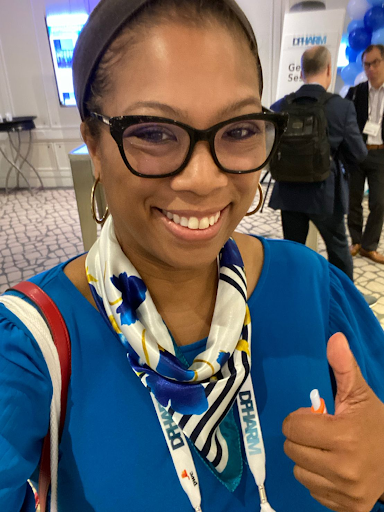
Juanice Mickles at the DPHARM Conference.
I took a deep breath and reassured myself that if I was not suitable for this project, I would not have been hired. You may be wondering how I got this opportunity in the first place, having no prior experience in pharmaceutical sales. In August, I participated in a free course on lab essentials, which was another “first” for me. One of the instructors is a Pfizer Inc. veteran and taught a lesson on the drug development process. After the class, he and I had a conversation and I expressed my gratitude for his presentation and eagerness to learn more about the pharmaceuticals industry. He owns a small consulting business and informed me that he was offered a complimentary ticket to a conference in Boston that he could not attend. After some follow-up conversations, we decided I would go to the conference in his place.
The conference agenda booklet provided a useful guide to specific panels throughout the 2-day event. The very first person to take to the stage was the “rockstar” Patient Advocate and Founder/CEO of Tigerlily Foundation, Maimah Karmo. Ms. Karmo set the tone for the conference with her harrowing story of growing up in the war-torn country of Libya, and her battle with breast cancer. Through her organization, Maimah aims to bridge the gap in health disparities through education and the power of shared experiences. The moderator was Peyton Howell of the biopharmaceutical manufacturing company Parexel. For those of us new to the industry, Parexel is one of the world’s largest CROs. Ms. Karmo is a breast cancer survivor, a successful business-owner, and an inspiration to many.
The opening keynote speaker was Vijay Govindarajan. Mr. Govindarajan is an author and professor at the Tuck School of Business at Dartmouth College. His enlightening talk on reverse innovation invited audience members to start thinking of the benefits of a more inclusive and global approach to patient care. The lack of accessibility and affordability to life-saving medical equipment is a barrier for millions of patients around the world. He proclaims that healthier people lead to a more productive society. He challenged corporations to invest more in the health of disparaged communities. His closing remarks left us with a call to action: “Do more for less, for more people.”
The next group of guests represented Pfizer Inc. in the big topic leaders panel: Informed Consent: Can we Achieve Radical Change for More Patients? Headquartered in my hometown of New York City, Pfizer is a well-known multinational pharmaceutical and biotechnology company. It is also somewhat of a household name, thanks to its production of the Covid-19 vaccine. Informed consent is the legal and ethical documented agreement between the patient and their care team. A relatable issue for all of us is the volume of the content within this agreement that most of us never read through. The Pfizer team discussed solutions to this problem, noting that the longer a form is, the less interested the patient will be in completing it. This results in retention issues, especially in the process of clinical trial participation. If the industry aims to reduce the burden on patients, the informed consent process must be made as easy to navigate as possible. Following the Pfizer discussion, visionary keynote speaker, Malcolm Gladwell, spoke. I am somewhat familiar with—at least I’ve heard of him (compared to everyone else speaking). Mr. Gladwell is the author of six New York Times bestsellers and is a staff writer for The New Yorker. The theme of his talk surrounded social sciences and the history of healthcare innovation.
Outside of the main dining hall, there were various breakout rooms called “Tracks” that consisted of smaller, more intimate engagements with attendees. Track B across the hall held the Preparing for FDA’s Diversity in Clinical Trials Initiative panel. Denise Janus, Chief Clinical Research Officer at Complion provided an overview of the U.S. Food and Drug Administration’s plan to tackle patient access barriers to clinical trials. In an FDA press release, an expansion to a previous guidance plan places more of the onus on sponsors of medical products to provide diversity in clinical trials. It is an important and complex topic that often leads to more questions than answers. There were many conversations surrounding enrollment barriers in communities of color. One of the most prominent barriers among the African American community includes a historically motivated mistrust of clinical trials. The Tuskegee experiments, which commenced in 1932, left a stain on the concept of clinical trials for many African Americans. Unfortunately, Blacks represent the lowest number of clinical trial participants despite having more health issues overall than other races. Tragedies like the Tuskegee experiments contribute to the reason informed consent is an important part of the patient experience. Along with other federal agencies, the updated draft guidance was issued this past April. It aligns with the Biden Administration’s Cancer Moonshot 2025 and aims to break down disparities and enroll more patients in clinical trials.
The variety of topics throughout the conference kept attendees engaged and each panel discussion piqued interest in the next. A highlight of the conference was the Ask the Patient program. This program connected conference attendees to clinical trial patients in roundtable discussions. Connecting with those that matter most (the patient community) is paramount to the notion of healthcare equity.
I thought about my own challenges with the healthcare system when I was first diagnosed with Lupus SLE in 2014. Soon I started incorporating personal healthcare challenges into my conversations. I stopped pretending I knew what I was doing and “Kept it real” by mentioning that I am new to the industry but eager to learn. That was my “A-ha!” moment! In retrospect, transparency is what contributed to the progression of being able to engage in more meaningful conversations. Once I improved my strategy, people were willing to help me. In fact, I introduced myself to Joe O’Rourke of WCG Clinical and told him exactly why I was there. He graciously offered to assist me in locating some key prospects! Even though I have years of experience in advertising and promotions, it took a fair amount of confidence to enter a world of hundreds of highly accomplished health industry professionals with no guidance. I had to think on my feet and focus on pockets of opportunity to “break the ice”.
By the end of the 2-day conference, I reached 90% of my intended prospects and another dozen or so key professionals. Some notable connections made were with: Acclinate, Pfizer Inc., IQVIA, Metadata, Captario, Advarra, and Regeneron. When I returned to my hotel, I immediately transferred my notes into an Excel sheet to keep track of conversational content. Early the next morning, I emailed the client a recap of the conference, as well as my notes and recommendations on possible leads. I also followed up on LinkedIn with everyone I met at the conference, thanking them for their patience in chatting with this “newbie”. Through this experience, I became a community member of The Lupus Research Alliance, and am a contributing member of NOWINCLUDED, which is a black health equity community owned by Acclinate. I even did my first live chat with NOWINCLUDED to tell the community about my Lupus story. I plan on continuing to learn about this industry, and hopefully, contribute to finding solutions to health disparities.
My takeaways from this new experience are:
Take conference notes. Type up more formal notes as soon as possible after the conference.
Have confidence in your capabilities.
Go for new challenges.
Connect personal experiences with topics of concern.
Be authentic and transparent.
Follow up by connecting via LinkedIn.
Contributor: Juanice Mickles